

Spain is where you come to live, not just work. Somewhere between the siestas and late night tapas, you realize that moments like these don’t have to be reserved for a two-week trip. And for thousands of people each year, the decision to teach English in Spain is what turns a vacation fantasy into an actual life.
I know, because I came to Spain to do exactly the same thing.
In 2024, I packed my life up into three suitcases and moved to Sevilla, where I spent the next nine months wrangling everyone from adorable toddlers to hyperactive 10-year-olds around a classroom. I know what it feels like to navigate a government portal in Spanish at midnight, to get placed in a school you’ve never heard of, and to build a life in a new city from scratch. It was far from easy, but not impossible — and if you feel called to, I know you can do it too.
Key Takeaways to Teach English in Spain
- 🇪🇸 Job Market: Spain is the largest English teaching market in Europe, with 40,000+ foreign teachers working across the country.
- 🧑🏫 Teaching Options: Government-sponsored language assistant programs, private academies, international schools, and freelance tutoring.
- 💶 Salary Range: Entry-level salaries range from €800–€1,000/month in government programs to €1,200–€1,600/month at private academies.
- 🛂 Visa Requirement: Non-EU citizens need a visa or sponsored work permit to teach legally. As of May 2025, that visa must be processed from your home country before you arrive.
- 🗣️ Qualifications: You often don’t need to speak Spanish in the classroom. A TEFL certificate and/or Bachelor’s Degree matters more than prior teaching experience for most entry-level positions.
This guide covers every route to teach English in Spain — from the government-sponsored programs to private academies — so you can figure out which path is the best fit for you.
Why Teach English in Spain?
In 2026, Spain remains the largest market for foreign English teachers in Europe, with an estimated 40,000+ language assistants, academy teachers, and private tutors working across the country. That number isn’t an accident. Spain has invested heavily in English bilingual education at the public school level for over two decades, and demand for native speakers has consistently outpaced the domestic supply.
For anyone who grew up without a clear path to living abroad, teaching English in Spain is one of the most structured entry points that exists. Government-sponsored programs handle your visa category, school placement, and provide a stipend. It’s not without its chaos (more on that later) but the infrastructure is definitely there.
Beyond the logistics, the quality of life is pretty fantastic. A three-course lunch with wine can run as low as $15. A glass of beer at a bar typically costs less than $3. In some programs, you’ll work only 14 hours a week and spend the rest of your time learning or improving your Spanish, traveling on weekends, and figuring out who you are outside your home country. Very few jobs in life can offer that arrangement, whether you’re 22, 32, or 42.

Already pricing out the move? Flight prices to Spain tend to dip in September and January, which lines up with many program start dates. Search flights to Spain here.
What's Required to Teach English in Spain?
The requirements to teach English in Spain vary depending on which path you take, but there’s a core set that applies across almost every route. Generally, Spain’s English teaching market runs on two minimum qualifications: a TEFL certificate and/or a bachelor’s degree. Here’s a quick overview of what’s required to teach English in Spain.
- Bachelor’s Degree: Often required for government-sponsored programs and international schools. Many private academies accept strong TEFL or CELTA credentials in place of a degree, particularly in smaller towns and cities.
- TEFL Certificate: A minimum 120-hour accredited TEFL is now the practical baseline for many positions at private academies. A Level 5 TEFL or CELTA typically earns €3-€7/hour more than a basic 120-hour certificate, according to the TEFL Institute.
- Native English Proficiency: Many programs require you to be a native or “native-like” speaker of English to participate, with many enforcing English-only in the classroom.
- Clean Background Check: Required for government-sponsored programs and most international schools.
- Basic Spanish: While it may not be required in the classroom, most programs recommend a functional level of Spanish for daily life.
- Age: Government-sponsored programs like NALCAP require participants to be 18-45 years old for the 2026-2027 program year.
- Health: A medical certificate is now required for all student visa applicants in Spain, effective May 2025 under Spain’s new immigration regulation RD 1155/2024.
Thinking about NALCAP? It's a government-sponsored program with a built-in visa and stipend, and the most popular route for Americans and Canadians. Check out the exact step-by-step guide I used to apply.
What Are Your Options to Teach English in Spain?
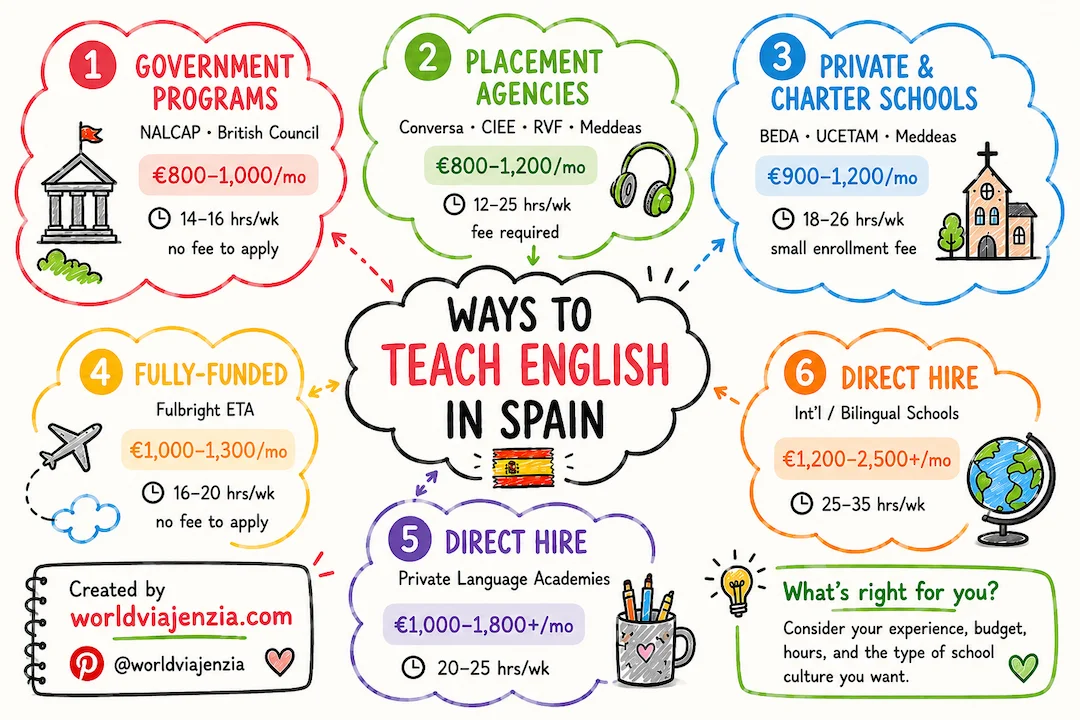
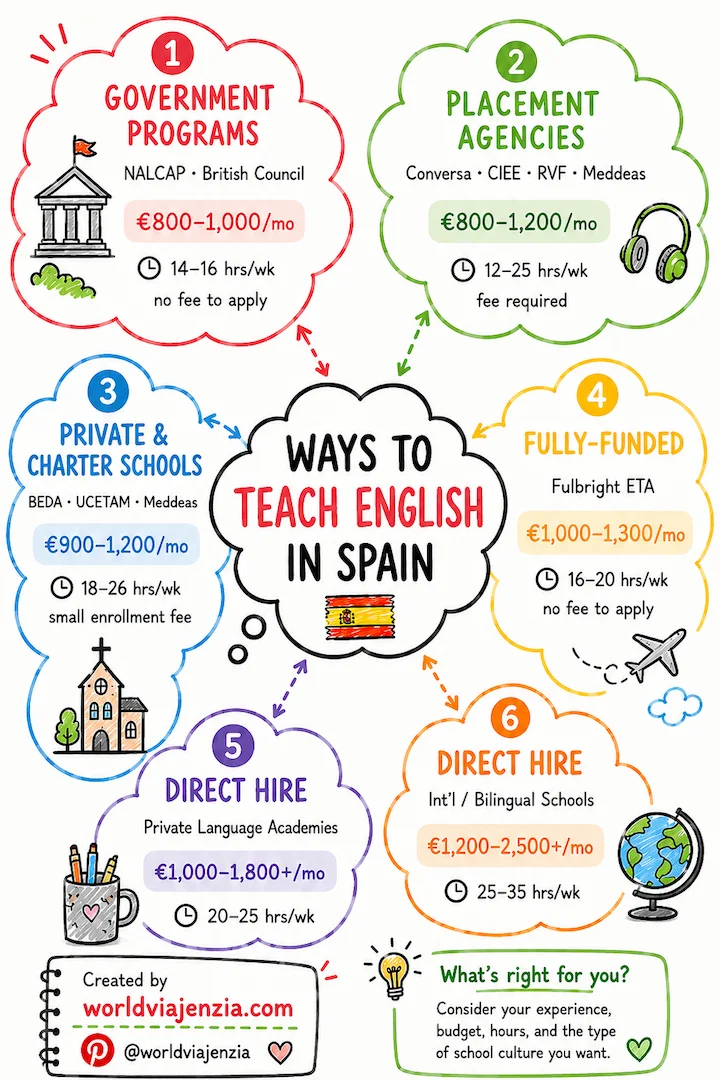
A quick search on how to teach English in Spain will almost always surface the same thing: the Spanish Ministry of Education’s Language Assistants Program. Which makes sense — it’s the biggest government program for applicants from North America and beyond. But it’s not the only route, and for some people it’s even not the right one.
The best program for you will depend on your citizenship, qualifications, and how much structure you want coming in. Keep on reading for a full breakdown of the main routes.
Auxiliar de Conversación Program
As mentioned, the government-sponsored Language Assistants Program is the most accessible entry point to teach English in Spain for most international teachers. The Spanish Ministry of Education places you as an auxiliar de conversación — a conversation assistant, not a lead teacher — in a public school for 14-16 hours per week. You receive a monthly stipend of €800-€1,000 depending on region, plus basic health insurance and a visa for the duration of the school year.
For North Americans, the program is known as the North American Language and Culture Assistants Program, a.k.a. NALCAP. For British citizens, the British Council runs an equivalent program. France, Germany, Australia, and many other countries also have bilateral language assistant agreements with Spain — you can check here to see if your country participates.
The advantages are consistent across all government programs: it’s free to apply, the visa pathway is built in, and you don’t need prior classroom experience.
There are some trade-offs, however.
While there is no program fee, you will be responsible for visa fees and filing paperwork on your own. You have little say in where you are placed, meaning you could end up in the city of Madrid or a small farm village over three hours away. Organization from the program is also notoriously slow, and some regions have faced disruptions in recent years.
For 2026-2027, the application window ran from June 2 to June 30, 2026, on a first-come, first-served basis.
Not sure if NALCAP is right for you? It's one of the most accessible ways to teach English in Spain, but it's not always the best fit. Get to know the good, bad, and ugly of NALCAP in this honest breakdown from someone who did the program.
Placement Agencies
If the idea of navigating all the visa paperwork solo feels like a lot, agencies that handle language assistant placements exist for exactly that reason.
Organizations like Conversa Spain and RVF International place teachers into the same public school network as NALCAP — literally the same auxiliar role — but charge a fee in exchange for support along the way. How much hand-holding you get varies by agency, and fees can run anywhere from a few hundred to over €1,000.
The pitch is peace of mind. I get the appeal, especially if you’ve never lived abroad before and the paperwork feels overwhelming. Several auxiliares I met went through RVF International and felt better for having the support, particularly around finding housing. But most of them also never gave themselves the opportunity to try applying on their own!
My honest take: that money is better saved for when you actually get to Spain.
The application has its quirks, but it’s doable (my step-by-step application guide walks through every part of it.) And if housing logistics are the thing that’s making you consider an agency, I have a guide on how to find an apartment in Spain coming soon.
Before You Decide💡
Agencies place you in the same schools as NALCAP. You’re paying for support, not a different experience. Whether that’s worth it depends entirely on you.
Private & Charter Schools
This is where things get a little more varied. Private and semi-private (concertado) schools run their own language assistant programs outside the Ministry system.
There are several different organizations that help place foreign language teachers in roles at these schools — but because they operate independently, the pay, hours, and costs all look a little different depending on where you land.
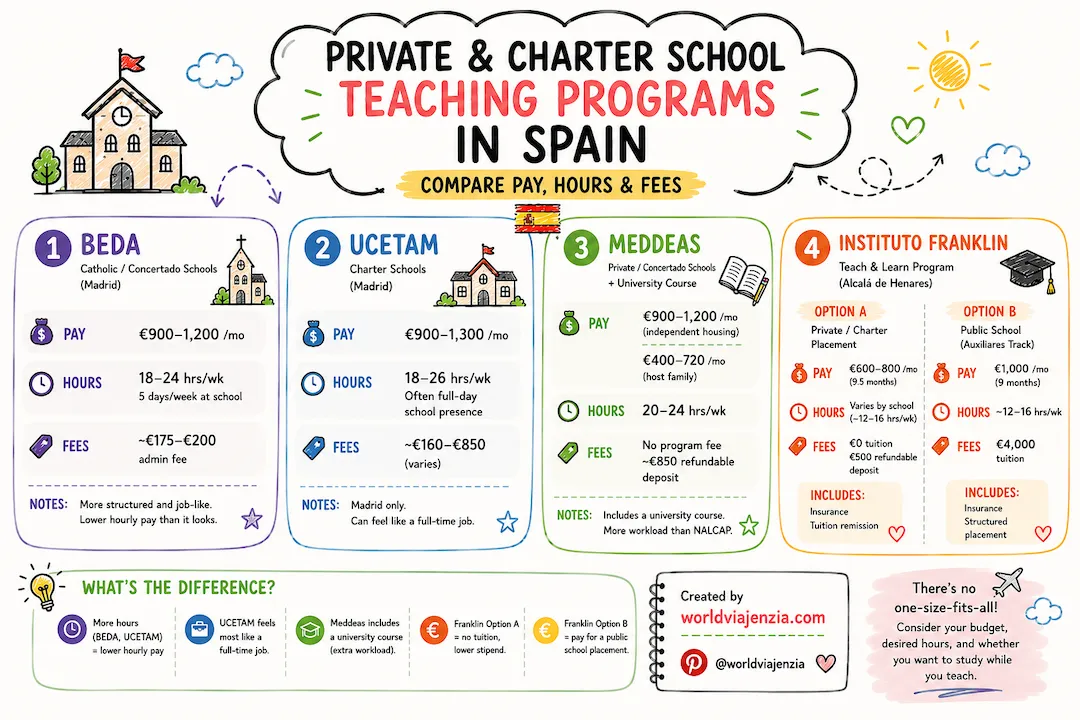
As a general ballpark, you can expect to be paid between €900-€1,200/month for 18-26 hours of work per week, with most programs costing anywhere between €150 to €850 to get started.
BEDA places teachers in Catholic schools mostly in Madrid. This program comes with more lead teaching responsibility than your typical auxiliar role, so come prepared to actually run a classroom. UCETAM and Instituto Franklin are smaller Madrid-area programs with a reputation for better in-person orientation and support.
Meddeas is probably the most internationally recognized name in this category. They place recent graduates from the US, UK, Ireland, Australia, New Zealand, Canada, and South Africa in private and charter schools across Spain, and they throw in a funded Post-Graduate ESL Certification through a Spanish university as part of the deal.
Keep in mind this is just a starting point — each program has its own application process, eligibility requirements, and timelines, and some even include interviews as part of the selection.
I’ve broken down all of them in more detail in a Best Programs to Teach English in Spain guide, so you can compare before you commit.
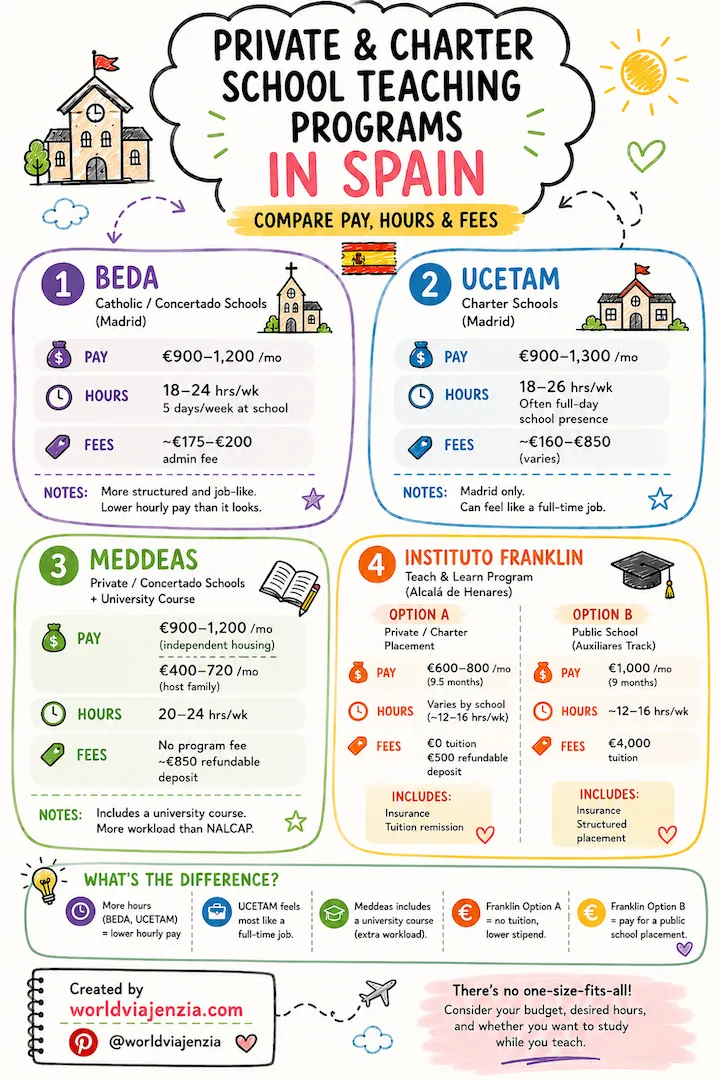
Private Language Academies
Academies are the backbone of English teaching in Spain. They exist in every city and town, hire year-round, and pay a bit more than government programs. Depending on your qualifications (TEFL, CELTA, and degrees), salaries range anywhere from €1,000-€1,600/month for 20-35 hours of teaching.
The catch? Academies generally prefer to only hire people who can work freely in Spain. So, if you’re a non-EU citizen, you’re going to need to secure your own work visa before arriving, or find a way to transition from an existing student visa.
While some academies might work with you to sponsor a work visa following your participation in a language assistant program like NALCAP, it’s unfortunately pretty rare.
International Schools
International schools offer the highest salaries in Spain’s teaching market — up to €1,800-€2,800/month in Madrid and Barcelona — with the highest bar to match.
Most require a bachelor’s degree, a recognized teaching license or Level 5 TEFL, and several years of classroom experience. Applications typically open 6-12 months in advance. Realistically, this path is best suited for teachers who want a career in international education.
Fulbright English Teaching Assistant Program
A Fulbright English Teaching Assistant Award (ETA) is the most prestigious route for U.S. citizens. The program is fully funded with flights, health insurance, and a living stipend that ranges anywhere from €1,000 to €1,300 for up to 16 to 20 hours of work per week.
As with any Fulbright award, the program is highly competitive, and the application process reflects that. If you’re a strong candidate who wants a résumé-defining experience and has the time to put into the application, it’s definitely worth attempting.

How Much Do English Teachers Make in Spain?
The short answer: less than you’d earn in South Korea or the UAE, but the quality of life often makes up for it. English teaching salaries in Spain run anywhere from €800/month as a government language assistant to €2,800/month at an international school in Madrid. Here’s a quick snapshot:
| Program type | Monthly salary |
|---|---|
| Government Assistants (via NALCAP, etc) | €800–€1,000 |
| Agency Placements (via Conversa, RVF, etc) | €800–€1,200 |
| Private & Charter Schools (via BEDA, Meddeas, etc) | €900–€1,300 |
| Private Language Academies | €1,000–€1,600 |
| Fulbright ETA | €1,000–€1,300 |
| International Schools | €1,800–€2,800 |
Before you get too caught up in the numbers, I want you to know: wherever you land in the pay range probably matters less than where you’re living when you cash that first paycheck.
In Madrid, a room in a shared apartment runs anywhere from €550–€900/month, and your expenses follow accordingly. In smaller cities and towns in Andalucía, the same room costs €250–€450, your grocery bill drops, and a stipend that would leave you stretched in the capital lets you live well and still take the occasional weekend trip.
Private tutoring is also worth factoring in. Most teachers build a small roster of private students within the first couple of months. A handful of students at €20 to €25/hour adds a few hundred euros to whatever your base salary is, across almost every program type.
You can find full salary breakdown by program in my Best Programs to Teach English in Spain guide, alongside everything else you’d need to compare your options before committing.
Location Matters Most 🗺️
The salary number in your contract tells you less than your zip code. Higher pay in cities will always have a higher cost of living attached, so plan accordingly.
How Do You Get a Visa to Teach English in Spain?
When I was applying for NALCAP, the visa process was easily the most confusing part — but it doesn’t have to be for you! Here’s what to know.
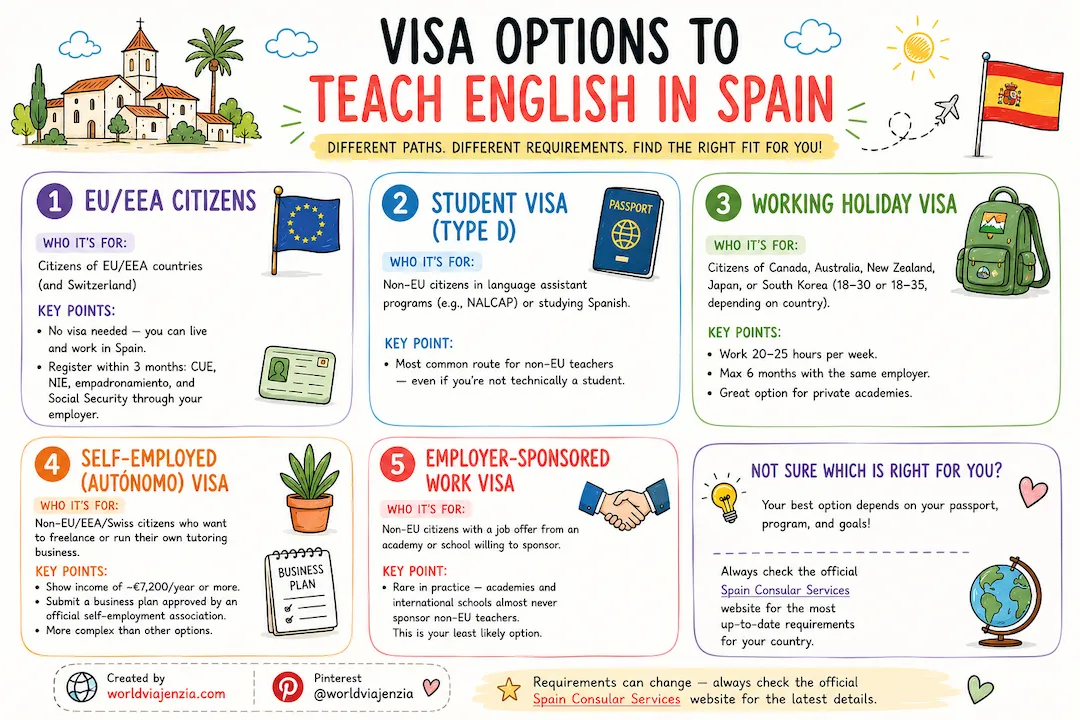
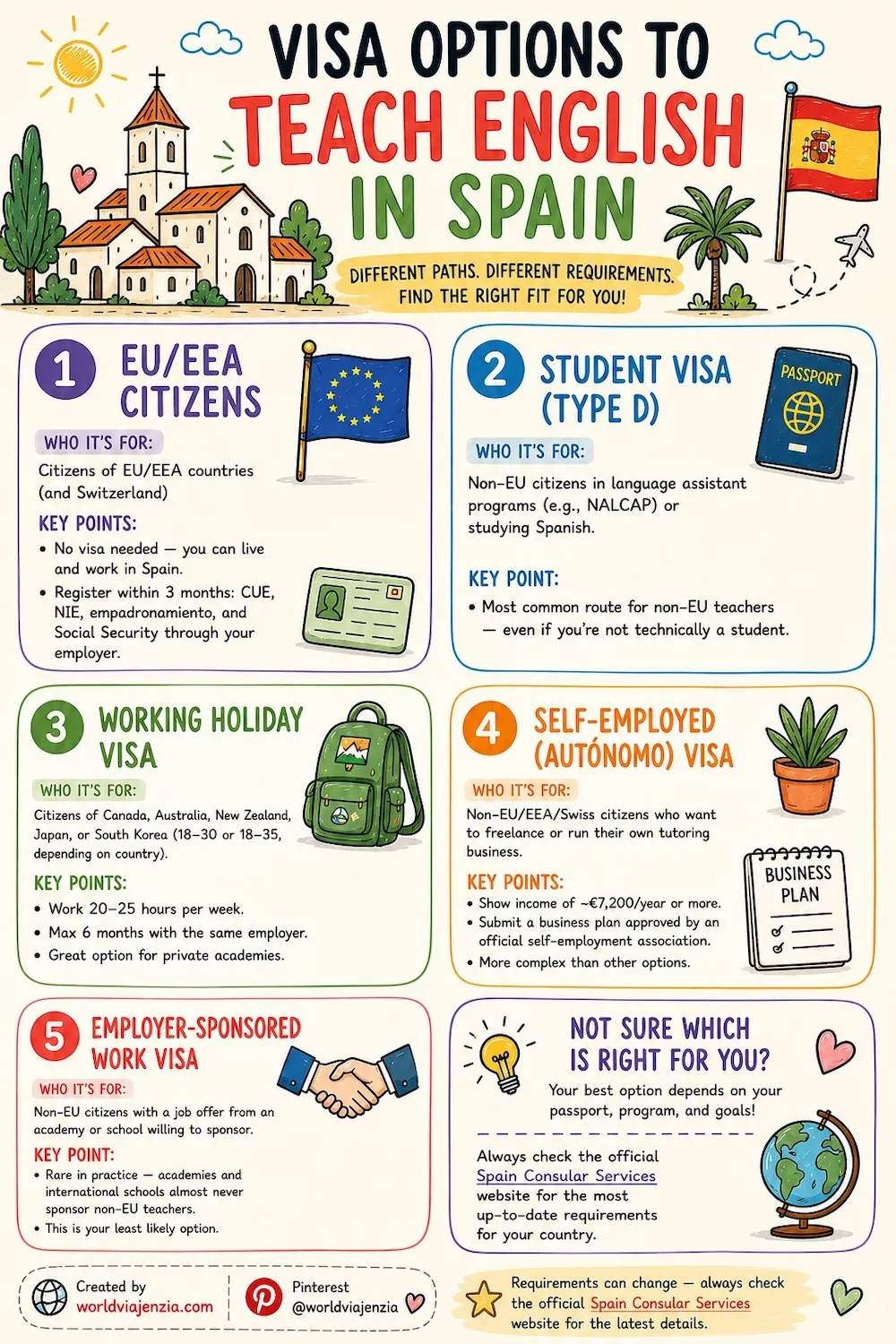
Spain has a few different visa categories that teachers end up using. For most people who decide to teach English in Spain, the student visa is the most common route (yes, even if you’re not a student — more on that below).
The best route for you depends on your passport and program of choice. I’ve broken down your options below:
EU/EEA Citizens
You can live and work in Spain without a visa. Lucky you!
There are a few administrative tasks to handle within three months of your arrival — this includes applying for your CUE (EU Registration Certificate); receiving your NIE (your foreigner identification number); listing your address at your local town hall (empadronamiento); and having your employer register you for Social Security before you start work.
If that all sounds complicated, just remember… you get to skip the visa chaos entirely!
Student Visa (Type D)
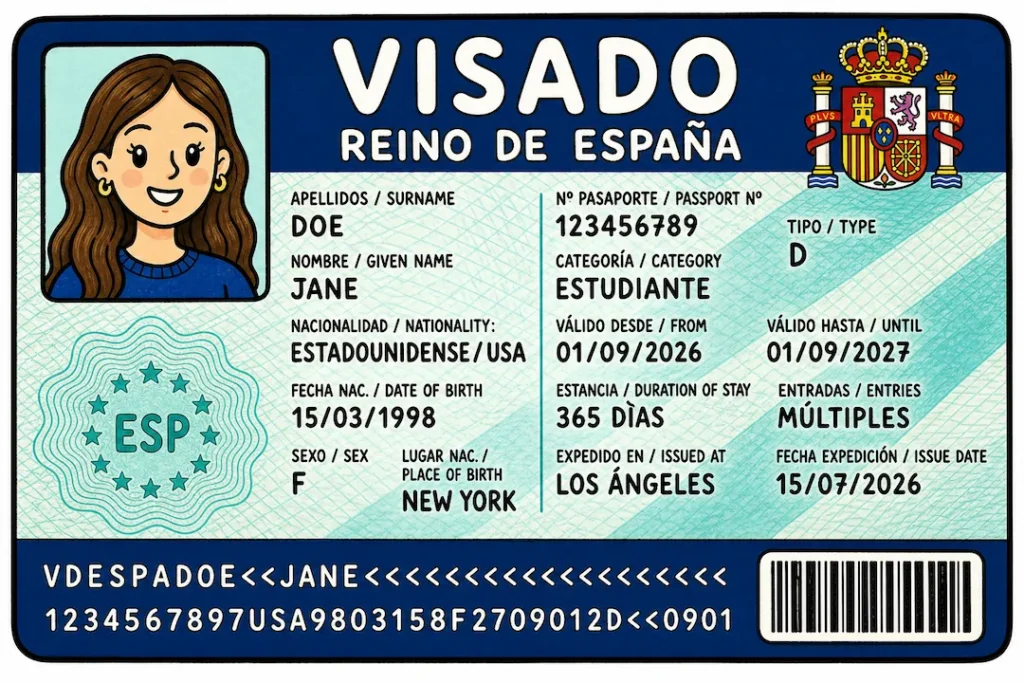
Non-EU citizens applying for NALCAP or similar programs will need a long-stay student visa, even if you’re not technically a student.
This is one of the more counterintuitive parts of the language assistant program: auxiliares are classified under the student visa category because the program is framed as a cultural and educational exchange, not employment. Your acceptance letter from the program is what allows you to arrive under this category, and you’ll present it to the nearest Spanish consulate (along with a bunch of other documents outlined in this guide) as part of your visa application.
If you’re going the private academy route instead, the picture is more complicated. The truth is, academies almost never sponsor work visas for non-EU teachers.
So, the most realistic route for most non-EU teachers who want to work at a private academy is still the student visa. You can enroll in an accredited Spanish language course, which qualifies you for a long-stay student visa and part-time work under a convenio de prácticas (internship-style) contract. While not a perfect solution, this is the most common workaround for those hoping to teach outside of traditional language assistant programs.
Working Holiday Visa
If you’re a citizen of Canada, Australia, New Zealand, Japan, or South Korea, you have one more option: a working holiday visa, which gives you direct access to the full private academy market. Under this visa type, work is typically limited to 20-25 hours per week and capped at six months with the same employer. Most countries also have a set age limit from 18 up to 30 or 35. Be sure to read up on the specific requirements for your country on Spain’s site for Consular Services.
Self-Employed (Autónomo) Visa
If you’re planning to freelance or build out a private tutoring business rather than work for an academy, Spain’s self-employed visa is an option. But as someone who personally looked into this path, I’ll caution that it’s a heavier lift than other options.
The visa is open to any non-EU/EEA/Swiss national, but you’ll need to show income at or above roughly €7,200/year and get a full business plan reviewed and approved by one of Spain’s official self-employment associations before you can even apply.
A better alternative for most self-employed folks is Spain’s Digital Nomad Visa — with the caveat that it’s designed for income earned outside of Spain, which usually isn’t your situation if you’re teaching locally.
Employer-Sponsored Work Visa
An employer-sponsored work visa is your last option. But be warned, it rarely happens in practice. Academies and international schools almost never sponsor work visas for non-EU teachers, since they’d have to prove no qualified EU candidate could fill the role.
What Is Life Like as an English Teacher in Spain?
Before you even set foot in a classroom, you’ll spend your first few weeks doing something far less rewarding: navigating Spanish bureaucracy. You’ll be registering your address at the local town hall, booking residency appointments, opening a bank account, and more — all while trying to figure out where to buy laundry detergent.
This checklist needs clearing before the actual adventure can begin, and none of it moves at the pace you’d like. I’d describe this stretch of time as equal parts overwhelming and oddly exciting, because buried beneath all the admin is the realization that you’re actually doing this!
📱 Stay connected on arrival: It can take some time to compare local phone plans, so I made sure I had service with an eSIM in the meantime. I use Saily whenever I'm in Spain, and you can get $5 off with my code JENZIA2371.
The teaching schedule itself typically leaves you with a lot of free time by American standards. What you choose to do with those open afternoons will end up shaping your experience in Spain as much as the job itself. If I can emphasize anything, it’s this: Spain rewards people who slow down enough to use that time wisely.
Finding community may take a little more effort than expected, but the opportunities are there: Facebook groups, WhatsApp chats, and language exchange meetups are the kind of low-stakes socializing that a relaxed schedule actually makes room for.
If you want the full picture of what day-to-day life looks like — the classroom, social circles, and the general rhythm of living in Spain as an English teacher — my post on Life as a Language Assistant in Spain covers it all.
🎫 Ready to start planning those weekend trips? From southern cities like Córdoba to quick hops over to Portugal or even the Canary Islands, there’s a lot you can fit into a typical teaching schedule. I used GetYourGuide and Klook to plan all kinds of activities.
What Can You Do After You Teach English in Spain?
Teaching English in Spain can be a single chapter in your life’s story, or it can be the start of a new one altogether. It depends entirely on what you decide to do after your first placement.
The most common option is staying. Government programs like NALCAP allow renewals for up to four years, and from there, a lot of teachers transition into the private academy market, where a few years of classroom experience and functional Spanish go a long way.
Others use the time to go deeper into a teaching specialty, or back to school at a Spanish university, where tuition is a fraction of what you’d pay in places like the States.
And of course, there’s always the option to come home. Which, contrary to all the live abroad content online, is a completely valid outcome! A year or two in Spain still gives you Spanish language skills, international experience, and a way of moving through the world that follows you wherever you end up.
When I was living in Spain, I couldn’t have told you exactly what came next. All I knew was that I’d become someone more flexible, more patient, and more willing to figure it out than the person who first stepped off the plane. Now, I carry that confidence on every new adventure.
There's No Wrong Move 🧳
Staying in Spain, going back to school, or coming home are all valid outcomes after teaching English in Spain. Each path after your first placement still counts as success.
Is Teaching English in Spain Right for You?
By now you know that teaching English in Spain is accessible to many, but that doesn’t mean it’s the right move for everyone. The people who thrive as English teachers in Spain tend to be the most honest with themselves about what they’re actually walking into.
A few questions worth sitting with before you apply:
- What are you actually hoping to get out of this? If the answer is money, Spain is not the highest paying market for teaching English abroad. Southeast Asia, South Korea, Japan, and the UAE all pay more for equivalent positions. But Spain delivers on quality of life, language acquisition, and location for broader European travel. If you’re comfortable with these trade-offs, then you won’t be disappointed.
- How do you handle uncertainty? Spain’s administrative systems are slow, inconsistently communicated, and occasionally maddening. The visa timeline, school placement system, TIE process — none of it runs on the schedule you’d prefer. People who can hold loosely to timelines and pivot when things change do well here. People who need certainty and clear communication will likely find it pretty stressful.
- Are you comfortable building community from scratch? Spain has a massive English teaching community, and it’s generally welcoming. But you still have to show up and find your people. The first few weeks in a new city where you don’t know anyone can be disorienting regardless of how much you researched it in advance.
- Do you have a financial cushion? I recommend arriving with no less than €3,000 to cover the gap between arrival and your first paycheck. The student visa also requires showing proof of €600/month for your intended stay. While it’s not impossible to come away with savings, the more likely reality is that you’ll break even (or even land in the red) after you teach English in Spain.
- Will you regret not taking the chance more than the risk itself? This is the question I kept coming back to when deciding if I wanted to teach English in Spain. For me, the answer was obvious. I picked the version of events that my 80-year-old self would look back on fondly, and I’m happier with this outcome than the version where I didn’t say yes. Your threshold for regret might be the same or different, so it’s up to you to decide!
Frequently Asked Questions
Can you teach English in Spain without a degree?
The answer depends on where you want to work. For government language assistants, a bachelor’s degree is typically required. For private academies, the answer is more flexible. Spain has no legal mandate that all teaching positions require a degree, and some academies, particularly in Andalusia and smaller cities, hire teachers who hold a strong TEFL certificate even without a bachelor’s degree. International schools, however, almost always require a degree and an accredited teaching license.
Do you need to speak Spanish to teach English in Spain?
Technically, no. Every NALCAP school and most academies enforce an English-only policy during lessons, and your role is specifically to model English for students. That said, Spanish is obviously useful for daily life. Finding an apartment, getting your NIE, navigating the grocery store without pointing at things — all of this is a lot easier with at least a conversational base. The Ministry of Education officially recommends a “basic level of Spanish” for their program.
How much money should you save before moving to Spain to teach English?
Assuming you already have a job lined up, I recommend arriving with at least €3,000 to cover the gap between your arrival and your first paycheck. If you still plan to job hunt when you arrive, you’ll want to save considerably more. Aim for a comfortable cushion for things like setting up a phone plan, groceries, and paying the security deposit on an apartment.
For the student visa route specifically, you must typically show proof of €600/month for your intended stay (around €5,400 for a full school year) as part of your visa application, though this doesn’t need to be cash you spend; it’s just a solvency requirement for the consulate.
Which teaching program in Spain is right for first-timers?
For those without extensive teaching experience, government assistant programs (like NALCAP) are the most accessible entry point — the visa pathway is built in, no program fees apply, and 14-16 hours per week leaves plenty of room to actually settle into a new country.
Private schools and academies often pay more and give more location control, but many require non-EU citizens to sort out their own visa pathway before arrival. If you’re weighing options, my guide on the Best Programs to Teach English in Spain breaks down each path in full.
What cities in Spain are best for English teachers?
The best city for you depends on what you want your life in Spain to actually feel like, not just what the salary looks like on paper. For me, living in Sevilla was a perfect fit. I had to budget carefully on a language assistant salary, but it still allowed me to live alone, cover groceries, occasional meals out, and a nice gym membership. I dipped into my savings to travel, since I could hop on a bus or a cheap Ryanair flight and be somewhere new most weekends.
Major cities like Madrid and Barcelona often pay more, but your euros don’t stretch nearly as far. Aside from Sevilla, cities like Valencia, Granada, and Salamanca tend to give you a better balance.
How long does it take to get a visa to teach English in Spain?
Processing typically takes 7-10 weeks at most Spanish consulates in the US. Apply at least 90-120 days before your intended start date to account for delays and the time needed to gather apostilled documents. As of May 2025, you cannot convert tourist status to a student visa from within Spain; the full application must be processed from your home country.
Ready to Start the Process?
Teaching English in Spain is one of the most structured paths into living abroad that exists, especially for first-gen travelers who don’t have a built-in network for this kind of move.
Yes, the paperwork feels endless at first. The bureaucracy can drive you nuts. But the life on the other side of it all is real, and for many of us, worth every headache it took to get there.
If you’ve decided on the government assistant route, my NALCAP application guide walks through every document and deadline. If you’re still weighing your options, I’ve compared the best programs to teach English in Spain side by side, so you can match one to your situation. And if you want more of my personal take on life as an English teacher in Spain, I’ve got you.
Thinking of
Moving to Spain?
Check Out These Resources
- Book your flight: I always start with Skyscanner to to find the cheapest window to fly. Since you’re moving, make sure to double check baggage allowances — you’ll have more luggage compared to a regular vacation!
 Get covered before you land: I’ve had to use travel insurance more than once, and it saved me thousands each time. SafetyWing covers long-term stays, which matters while you wait on Spanish health insurance.
 Book a short-term place to stay: Do not sign a lease before you land. Booking.com is where I booked my first stay in Sevilla while I searched for an apartment in person.
 Explore once you’re settled: Once the paperwork is done, GetYourGuide is my go-to for exploring your new city and region. They partner with local operators, which matters to me when booking.
 Stay connected when you land: Download Saily before your flight so you have data the moment you touch down. You can use code JENZIA2371 for $5 off your first plan.
 Pack to move, not vacation: A move-specific packing guide is coming soon, but my travel essentials page covers the bare minimum essentials that made it with me to Spain.
Save to Pinterest 📌