


Maybe you’ve been scrolling social media and seeing dozens of posts from people teaching English in Spain. If your algorithm is anything like mine was, your feed is already full of sunset photos from Seville and wine bars in Barcelona. Or maybe you just want to live somewhere for a year that isn’t where you are now, and getting paid to do so sounds like a fantastic idea.
The best programs to teach English in Spain can actually make all of this a reality. In many cases, you don’t even need a teaching degree or to be fluent in Spanish to qualify. What you do need is to understand your options, because the English teaching landscape in Spain is wider than most people realize.
If you’re still deciding whether this move makes sense for you, my complete guide to teaching English in Spain gives you an overview of the process from scratch. This post assumes you’re already past that and officially ready to start comparing the best programs to teach English in Spain!
Key Takeaways – Best Programs to Teach English in Spain
Pay Range: Monthly pay can range from €400 to €1,300, depending on your program, hours, and whether you’re placed in a public or private school.
Program Pauses: Conversa Spain and RVF International both paused their 2026–27 cycles amid disruption to Spain’s Ministry-run Auxiliares program.
Program Fees: Six of the nine programs are free to apply, but there are still costs to keep in mind for almost every program.
Competitiveness: The Fulbright ETA and Auxiliares de Conversación sit at opposite ends, from most competitive to most accessible.
As a quick overview, teaching in English in Spain will usually come down to one of two paths: a public school placement through Spain’s Ministry of Education, or an independent program that places you in a charter, private, or Catholic school.
Some programs come with a certification or degree. A few charge fees for support and a guaranteed placement. All of them get you a visa, a modest monthly stipend, and typically, a lot more free time than a standard job back home.
One disclaimer before we dive in: Programs shift year to year, so please treat everything below as a snapshot. Make sure to double-check official program websites before you commit to anything, especially if there are any fees involved. I’ve linked and verified these pages throughout this article.
With that out of the way, let’s compare the 9 best programs to teach English in Spain.
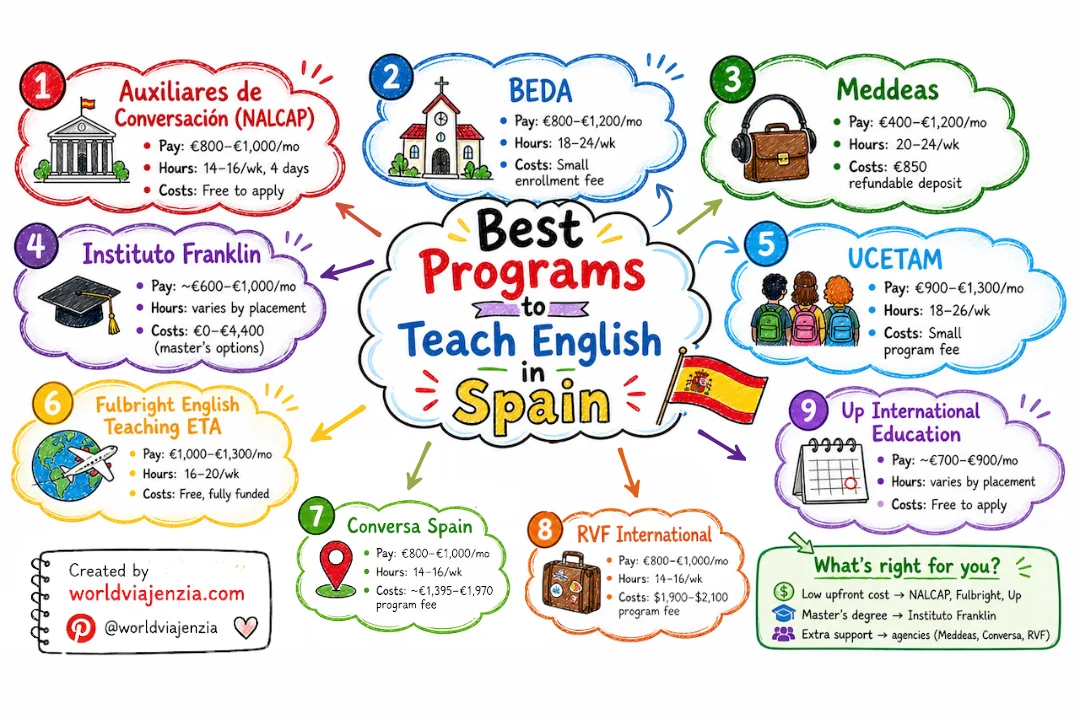
9 Best Programs to Teach English in Spain
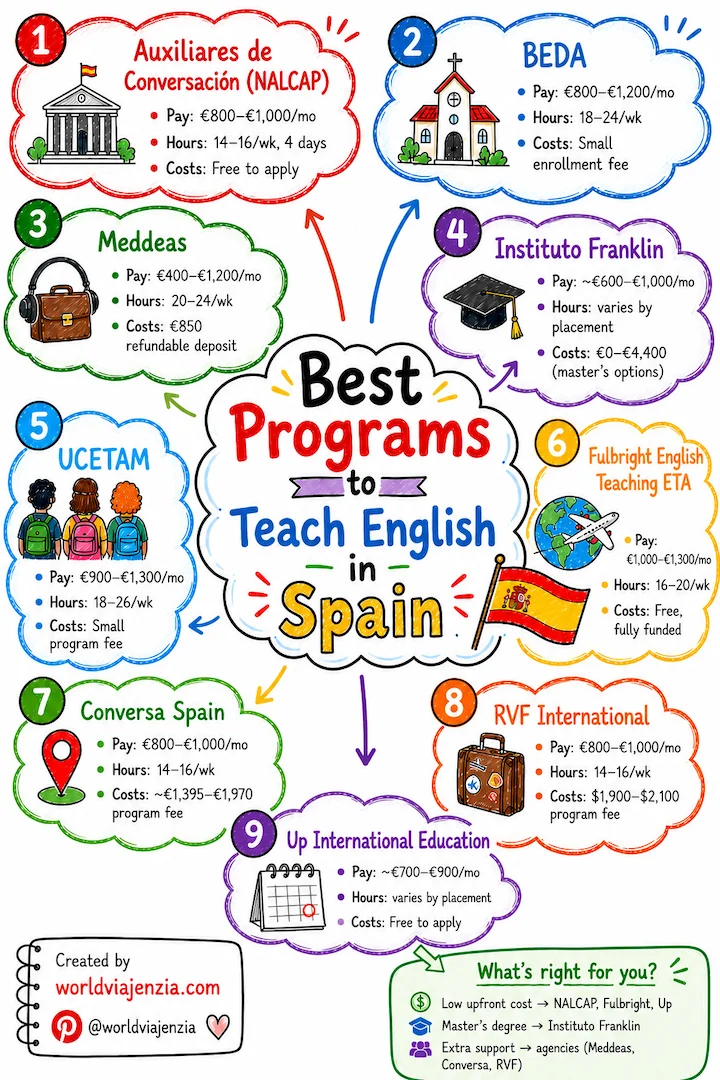
Auxiliares de Conversación
Pay: €800-€1,000/month
Hours: 14-16/week, typically 4 days
Location(s): Public schools nationwide
Costs: Free to apply
Requirements: Ages 18-45; native-level English; BA, BS, AA, or AS degree, or degree in progress
Language Assistants Program – At a Glance
Spain’s flagship language assistants program, run by the Spanish Ministry of Education, is the program you’ll hear about the most when people talk about teaching English in Spain.
For Americans and Canadians, it’s branded as NALCAP (North American Language and Culture Assistants Program), but the underlying program is open to a long list of countries beyond North America — including Australia, Brazil, India, the Philippines, Singapore, and most of Europe, each routed through their own national application track.
It’s free to apply (though you’re on the hook for your own flights and visa fees like nearly every other program on this list.) During the application process, you’ll rank up to three regions of choice, note your preference for city vs. small town, and get matched with a public school for the school year. Placements are first-come, first-served.
Language Assistants Program – Pros vs. Cons
Free to apply
Open to many nationalities
No teaching experience or TEFL required
No penalty or fee if you want to walk away
Typically a light schedule, with long weekends included for most placements
Pros
Cons
You’re on your own for visa paperwork, housing, and transportation
Little say in where you actually end up
First paycheck often shows up months late
Demands may exceed your job description
Program instability in recent years
The tradeoff for the low barrier to entry is unpredictability. Your preferences aren’t always matched, pay delays are common, and in recent years, the program has faced some turbulence, causing several regions to pull out from participating in the latest cycle.
For the 2026-27 cycle, the application window ran June 2-30, 2026, with the program itself running November 1, 2026 through May 31, 2027. In past cycles, the application period has opened as early as January, so check the official Auxiliares de Conversación page for your country’s current dates before you start collecting paperwork.
For a full document checklist and walkthrough of the process, see my step-by-step NALCAP application guide. Plus, an unfiltered verdict on NALCAP from someone who actually did the program (yours truly).
🏠 Line up temporary housing: Almost no program on this list guarantees your apartment before you land. Budget for at least two weeks at an Arbnb, VRBO, or hotel while you apartment hunt in person.
BEDA (Bilingual Education Development & Assessment)
Pay: €900-€1,300/month
Hours: 18-24/week, 5 days
Location(s): Catholic schools, mostly in Madrid
Costs: €200 non-refundable enrollment fee
Requirements: Ages 20-56; native-level English; Bachelor’s degree; prior teaching experience preferred
BEDA Program – At a Glance
BEDA (Bilingual Education Development and Assessment) places language assistants in Catholic schools through Escuelas Católicas de Madrid. The program is independent of the Ministry’s public school system, which has made it one of the more stable options for teachers in years when the government program has hit turbulence.
The hours run longer than classic Ministry placements, and BEDA schools tend to expect more from their assistants. This makes it less of a purely conversational role and more of a true teaching assistant position. In exchange, the pay is slightly higher than NALCAP.
BEDA Program – Pros vs. Cons
Independent of the Ministry system’s unpredictability
Higher pay than most programs here
Comes with a university certification
Strong program organization and support, including help with NIE/TIE paperwork
Reliable, on-time pay by most accounts
Pros
Cons
No say in school or city placement
Higher expectations and workload compared to typical assistant positions
Mandatory certification classes (conducted online or in-person, depending on location)
More involved application process, including an online interview
All BEDA participants will also walk away with a certification as specialized bilingual teachers. Language assistants are automatically enrolled in hybrid university coursework through Universidad Pontificia Comillas alongside their teaching hours to complete this certification. The coursework is relatively light, and carried out online or in-person depending on your placement city.
BEDA is more competitive than NALCAP, with roughly ten applicants for every spot in recent cycles. The application involves an interview, with timelines varying by residency and visa status. For the 2026-27 cycle, non-EU applicants could apply through August 31, 2026, whereas EU passport holders (and those already holding valid Spanish residency) have until February 28, 2027. Check the BEDA application page to confirm, since these dates can shift each cycle.
Meddeas
Pay: €409-€1,267/month
Hours: 20-24/week, 5 days
Location(s): Private & charter schools nationwide
Costs: €850 refundable deposit
Requirements: Minimum age 18 (no age limit); native-level English, French, or German; degree within last 4 years
Meddeas Program – At a Glance
Meddeas places over 600 language assistants a year in private and charter schools across Spain. The program stands out for offering an option to live with a host family as well as independently, which explains why the pay range is so wide. Similar to BEDA, participants also get a funded post-graduate ESL certificate through a partner Spanish university alongside their teaching hours.
There’s no fixed application deadline. Meddeas reviews applications on a rolling basis, generally starting their review about seven months before each cycle’s start date, so earlier applicants seem to get slightly more say in their placement preferences.
Meddeas Program – Pros vs. Cons
Choice between independent housing or living with a host family
Comes with a funded TEFL certificate
Easy to renew for a second year
More flexible language requirements; French and German speakers are also welcome to apply with B2-level English
Pros
Cons
More hours for roughly the same pay as language assistants with NALCAP
No say in your placement location
Private medical insurance is not included
Deposit gets forfeited if you quit
Host-family placements can sometimes come with the expectation of unpaid tutoring
The application process for Meddeas is more involved than most programs on this list, requiring a written application and two interview cycles. But it has one of the more flexible language requirements (French and German speakers are also needed, and qualify as long as they also hold a B2 level of English), making it more accessible to non-native speakers.
Reviews of the Meddeas experience are somewhat mixed. Some assistants describe strong in-country support and would renew without hesitation; others have flagged specific placements where support fell short, so it’s definitely worth asking plenty of questions and making your preferences clear during the interview process rather than assuming every placement is the same.
Instituto Franklin (Teach & Learn in Spain)
Pay: €600-€1,000/month
Hours: Language assistant hours, plus coursework
Location(s): Public & charter schools throughout Comunidad de Madrid
Costs: €150-€4,400 depending on option
Requirements: A bachelor’s degree in any field (with a GPA of at least 3.0) and native-level English.
Instituto Franklin Program – At a Glance
This is the one program on this list built entirely around an academic degree. Run by Instituto Franklin at Universidad de Alcalá, it combines a 60-ECTS máster propio (an institutional, doctorate-track master’s) with a language assistant placement in the Madrid region.
For those looking to work as language assistants, there are two tracks to choose from in the program: a limited number of tuition-free Option A spots in private or charter schools, or full-tuition Option B placements at public schools tied to the Ministry program. Both options require a non-refundable application fee of €150. Full tuition for the program costs €4,400 as of 2026, plus a €100 medical insurance fee. Since Option B depends on the separate Ministry program’s own timeline and regional participation, Instituto Franklin recommends having a funding backup plan in case that piece falls through.
Instituto Franklin Program – Pros vs. Cons
Only academic degree program on this list
Tuition-free option exists
Built-in cohort and university structure
Great on resume for future teaching or academic work
Best option if grad school is on your radar
Pros
Cons
Coursework plus teaching hours makes for a packed schedule
Máster Propio isn’t universally recognized
Option B placement depends on the separate Ministry program’s timeline
Priciest route on this list if you’re not eligible for tuition-free Option A route
Participants will take on-site classes in Alcalá de Henares alongside their teaching hours, which makes for a pretty demanding schedule, especially early in the year. For anyone chasing academic credibility outside Spain, it’s also worth knowing that Instituto Franklin’s máster propio isn’t automatically recognized as equivalent to an official máster universitario, a.k.a. a traditional Master’s Degree. If you plan to use the degree for further study or specific job requirements outside of Spain, it’s worth confirming recognition in your home country first.
For the 2026-27 cohort, applications ran January 12 through March 20, 2026, with an extension to April 24 for candidates already living in Spain. That window has closed, so if you’re reading this after March of a given year, you’re likely looking at next year’s cohort. Check the application requirements and deadlines page each cycle for current dates.
UCETAM (Unión de Cooperativas de Enseñanza de Trabajo Asociado de Madrid)
Pay: €900-€1,300/month
Hours: 18-26/week
Location(s): Charter schools throughout Comunidad de Madrid
Costs: €150 university registration fee
Requirements: Bachelor’s degree; native-level English; prior experience working with children
UCETAM Program – At a Glance
UCETAM’s English Language Assistant program, run in partnership with Universidad Autónoma de Madrid, places assistants across the Madrid region (many assistants are placed in smaller towns rather than the capital itself). Like BEDA and Meddeas, UCETAM is bundled with a university teacher-training course. The program also offers public or private health insurance, and at many schools, free daily lunch.
There’s no age limit to apply for UCETAM, which sets it apart from some of the other programs on this list. The application process involves submitting a letter of recommendation and a current resume, followed by video interviews for shortlisted candidates. Because placements lean toward preschool and schools outside central Madrid, it’s worth being upfront in your application about your comfort level with a longer commute or younger ages.
UCETAM Program – Pros vs. Cons
No age cap, unlike most programs here
Free lunch at many placements
Comes with a structured teacher-training course for real university credits
Easy to renew for a second year
Solid option if you want practical teaching experience, not just conversation assistance
Pros
Cons
Mandatory training adds several in-person sessions to your schedule
Role leans closer to teacher than conversation assistant, with a heavier workload and expectations
Mixed reviews on help with visa, housing, and transport logistics
For the 2026-27 cycle, applications were accepted February 2 through March 27, 2026. The program itself runs late September through mid-June. Since UCETAM draws on the same regional Ministry framework as the public Auxiliares program, its availability can shift if Madrid’s participation in that broader system changes year to year. Confirm current dates on the UCETAM application page.
Conversa Spain
Pay: €800-€1,000/month
Hours: 14-16/week, typically 4 days
Location(s): Madrid and Murcia
Costs: €1,395-€1,970 depending on option
Requirements: Bachelor’s degree; native-level English; aged 20-59
Conversa Program – At a Glance
Think of Conversa Spain as a fee-based shortcut to the government’s language assistant program. Pay them, and they guarantee your city (Madrid or Murcia) instead of leaving it entirely up to the Ministry’s lottery.
Their program fee also covers visa support, an optional immersion week or TEFL course, and general hand-holding through the bureaucracy. It’s important to note, however, that since Conversa draws from the same pool of public school placements as the wider Ministry program, the organization has faced the same unpredictability as programs like NALCAP in recent years.
Conversa Program – Pros vs. Cons
Guarantees specific regions
Support with visa paperwork and logistics
Optional immersion week or TEFL add-on
Straightforward for anyone already set on living in Madrid or Murcia
Three-day weekends at most placements
Pros
Cons
Fee is due upfront, with no payment plans
Support has been described as more of “here’s a tip” than hands-on help
Paused for the 2026–27 cycle, with availability uncertain
Only two placement regions, with less flexibility than nationwide options
As of 2026, Conversa Spain paused its program for the 2026-27 school year, citing ongoing uncertainty in the broader public school system it depends on. But a paused cycle one year doesn’t necessarily mean the program is gone for good. If a guaranteed placement in Madrid or Mucia is important to you, it’s always worth checking their current status page for updates.
RVF International
Pay: €800-€1,000/month
Hours: 14-16/week, typically 4 days
Location(s): Public schools nationwide
Costs: $2,100 program fee
Requirements: Bachelor’s degree; native-level English; aged 20-45
RVF International Program – At a Glance
RVF International is another agency providing public school placements, built around 1:1 visa guidance, housing search support, and a built-in community of other RVF participants in your region. It’s one of the better-reviewed agencies in this space, with strong ratings from past participants who valued the support with visa paperwork and arrival logistics.
That said, the level of support you receive may or may not be worth the money. You’re primarily paying for worksheets that walk you through the visa process step-by-step. If you’re serious about applying to teach English abroad, you can absolutely DIY it with my free NALCAP application guide. In the guide, I walk through every form and deadline without the agency markup!
RVF Program – Pros vs. Cons
Visa and housing support
Community of other RVF participants
Handles some of the logistics for you
Easy to renew for a second year
Pros
Cons
High fee when free public options exist
Mixed reviews on whether price is even worth it for the level of support received
Placement still comes down to the Ministry’s lottery system and timeline
Like Conversa Spain, RVF allocates slots from the same Ministry-run system that NALCAP uses, which means its availability runs according to that broader program. RVF paused its 2026-27 cycle and, as of this writing, is finalizing details for the 2027-28 program year instead, meaning applicants applied a year ahead of a typical cycle. Their Spain program page keeps an updated snapshot of program dates and application availability.
Up International Education
Pay: €700-€900/month
Hours: Varies by placement
Location(s): Private schools nationwide (Navarra, Madrid, Catalonia, Andalucía, Galicia, etc.)
Costs: Free to apply
Requirements: Bachelor’s degree; native-level English; aged 18-35
Up International Program – At a Glance
Up International Education is a small, fee-free program that places teaching assistants in private schools throughout the country. This independence from the public school system means the program is mostly insulated from any of the disruptions that have taken place with Ministry-linked programs in recent years, making it another reliable alternative to NALCAP.
Each assistant with Up International gets a dedicated support representative for paperwork, visa questions, and general troubleshooting throughout the year. Assistants also get access to a free postgraduate-style training course (STEP) during the placement.
Up International Program – Pros vs. Cons
Fully insulated from Ministry disruptions
Free training course included
Dedicated support representative
Option to easily renew for a second year at the same school
Free to apply
Pros
Cons
Thin public track record overall
Smaller program means less built-in community than the bigger names
Under-35 preference narrows eligibility
Placement hours vary by school, making them harder to predict upfront
The selection process for Up International is a bit more involved than some of the other programs on this list. Applicants can expect to sit for a native speaker group interview and an online quiz assessment. After this initial screening, you’ll have another interview to determine your ideal school placement, and finally, your school will confirm the placement via video conference.
The program tends to appeal most to people building toward a longer-term career in education, given the training component and the option to renew for a second year at the same school. When renewals come around annually, Up International handles paperwork and appointment booking, which is a “really nice” perk according to participants who’ve navigated visa renewals elsewhere (where you’re often on your own).
Fulbright English Teaching Assistant Program
Pay: €800-€1,000/month
Hours: 14-16/week, typically 4 days
Location(s): Madrid and Murcia
Costs: €1,395-€1,970 depending on option
Requirements: Bachelor’s degree; native-level English; aged 20-59
Fulbright ETA Program – At a Glance
The Fulbright ETA program is the most prestigious and most competitive route on this list. Funded by the U.S. Department of State, the grant covers round-trip flights, health insurance, and a monthly stipend based on your placement region’s cost of living, plus a project allowance for the community initiative you’re expected to run alongside teaching.
Placements run through regional co-sponsors, so your experience can vary depending on where you land — whether that’s a rural school in Asturias or a writing center placement at a university in Madrid. Intermediate Spanish is required for every placement type, and prior teaching experience, while not mandatory, will definitely strengthen your application.
Fulbright ETA Program – Pros vs. Cons
Free to apply
Open to many nationalities
No teaching experience or TEFL required
No penalty or fee if you want to walk away
Typically a light schedule, with long weekends included for most placements
Pros
Cons
You’re on your own for visa paperwork, housing, and transportation
Little say in where you actually end up
First paycheck often shows up months late
Demands may exceed your job description
Program instability in recent years
Fulbright runs on its own annual cycle, roughly a year ahead of the program’s actual start date. The 2027-28 competition is open now, as of this writing, with a national deadline of October 6, 2026, for a grant that begins the following September. Applicants must not have lived in Spain during the year immediately before the grant (this means time spent in Spain as an auxiliar de conversación counts as residency). Full details and current deadlines are on the Fulbright Spain ETA award page.
Frequently Asked Questions
Do I need to speak Spanish to teach English in Spain?
No program on this list requires fluent Spanish, though a few, like Fulbright, do require intermediate proficiency. That said, everyday life will be heaps easier with a basic level of Spanish at a minimum, even if your classroom role is English-only.
Do I need a TEFL certificate to teach English in Spain?
Not for any of these nine programs. Each program on this list is built around the requirement of being a native or native-level English speaker rather than a certified teacher. While a TEFL isn’t a requirement, it can strengthen an application and helps if you plan to pick up private tutoring on the side.
Which programs pays the most per month?
BEDA, UCETAM, and the Fulbright ETA tend to land at the higher end of the range, often €1,000 to €1,300 a month, while the standard public Auxiliares stipend and most agency programs sit closer to €800 to €1,000.
Can I apply to more than one program at the same time?
Yes, and plenty of people do exactly that! Not all of these programs coordinate with each other, so applying to two or three at once — ideally a mix of free, public options and private placements — gives you options in the event of any single program’s delays or cancellations.
What visa do I need for these programs?
Nearly all of these programs operate on a long-stay Spanish student visa, arranged through your nearest Spanish consulate once you have a placement or acceptance letter in hand.
Fulbright grantees and EU passport holders go through a different process, so confirm the specific requirement with your program once you’re accepted. My complete guide to teaching English in Spain breaks down the visa requirements in more detail.
So, Which Program Is Right for You?
If free time and a low barrier to entry matters most to you, the Ministry’s Auxiliares de Conversación program (NALCAP for North Americans) is still the default starting point. If you want a credential attached, look at BEDA, UCETAM, or Instituto Franklin.
Want a guaranteed city and someone else to handle the annoying paperwork? RVF International has the strongest track record among the fee-based agencies.
And if you’re a US citizen with a resume that can compete nationally, the Fulbright ETA is the fanciest version of this same job.
🎯 Hedge Your Bets
Applying to two or three programs at once — one free public option and one fee-based agency — is a smart way to protect your timeline if any single program doesn’t work out.
For a closer look at what the day-to-day actually feels like once you’re placed, my post on Life as an English Teacher in Spain covers the classroom reality behind all the paperwork.
And lastly, whichever program you’re considering, things change often enough that the official program websites — not a blog post (yes, even this one!) — should be the official last word before you submit an application or pay a deposit. Make sure to stay up to date and feel free to drop any questions below!
Ready to
Teach English in Spain?
Check Out These Resources
Secure your flight: I always use Skyscanner to lock in the best deal for a long flight. Since you’re relocating for a teaching contract, pay attention to baggage limits. You’ll need extra room for both casual and school-appropriate clothing!
Get insured before you arrive: Travel insurance was essential during my time as an auxiliar, protecting me through some unexpected costs. SafetyWing handles extended stays, which is perfect while you’re waiting on your Spanish health coverage to activate.
Find temporary housing: Please avoid signing a year-long lease before you arrive! Booking.com is where I found my first place in Sevilla while I viewed apartments near my school in person.
Explore your teaching city: Once you’re settled into your placement, GetYourGuide became my way to dive into the local culture and neighborhoods.
Get data immediately upon landing: Set up Saily before takeoff so you’re connected the minute you land in Spain. Use code JENZIA2371 to save $5 on your first plan.
Pack like you’re staying, not visiting: A full packing guide for teachers is coming soon, but my travel essentials page has the core items that got me through my first year of teaching in Spain.
Save to Pinterest 📌